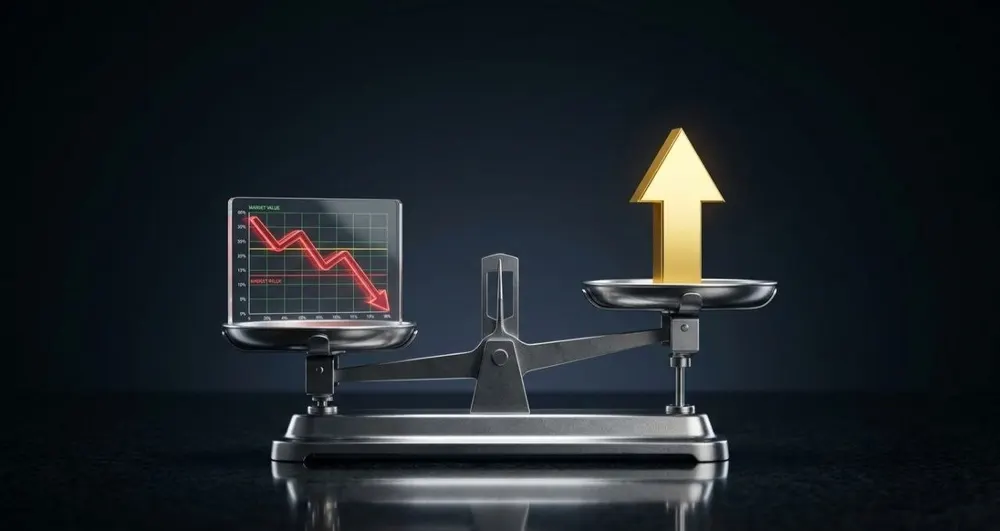
How to Profit from Market Corrections
The price never rises or falls in a straight line. During an uptrend, traders periodically take profits, causing the price to drop slightly. During a downtrend, sellers pause, and the price temporarily rises. It is precisely these temporary movements against the main trend that are called a correction (or pullback). To track these moments and keep accurate statistics on your trading, use our online trader’s journal. Opening trades at the very peak of an impulse is a common mistake. The ideal entry point occurs immediately after the pullback ends.
A Strategy for Identifying Signals During a Pullback
To find the best entry point, you can use this simple candlestick rule:
- In an uptrend: wait until 2–3 red candles (downward movement) form on the chart. As soon as the pullback slows down, open a long position.
- In a downtrend: wait for 2–3 green candles to appear (an upward pullback), and then open a short position.
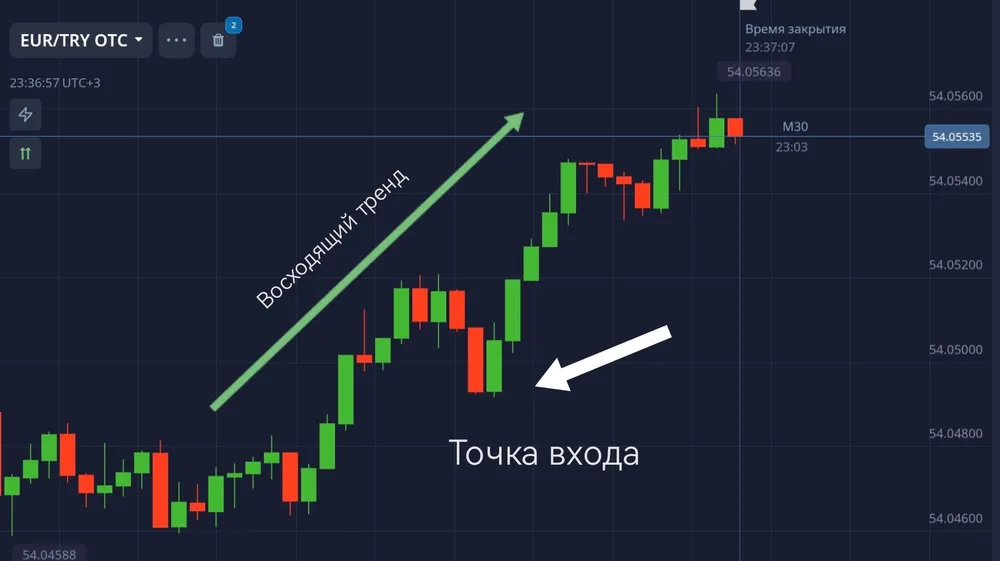 Entry into a Buy Trade
Rule on Rollback Depth and Risk Management
How can you tell if what you're seeing is still a correction and not a full trend reversal?
- Safe Zone: The correction should not exceed 50% of the length of the previous impulse move.
- Danger Zone: If the pullback extends beyond the midpoint of the previous impulse, the trend is at risk. Entering a trade in the same direction becomes too risky.
Checklist Before Entering a Trade
- What is the overall trend? (Determines the direction of the trade: up or down.)
- Where exactly am I opening a position? (This determines the quality of the entry point: whether the correction has truly ended.)
Even the basic strategy, which is based on identifying trend corrections, allows you to close more than 60% of your trades at a profit.
Open Trading Journal →