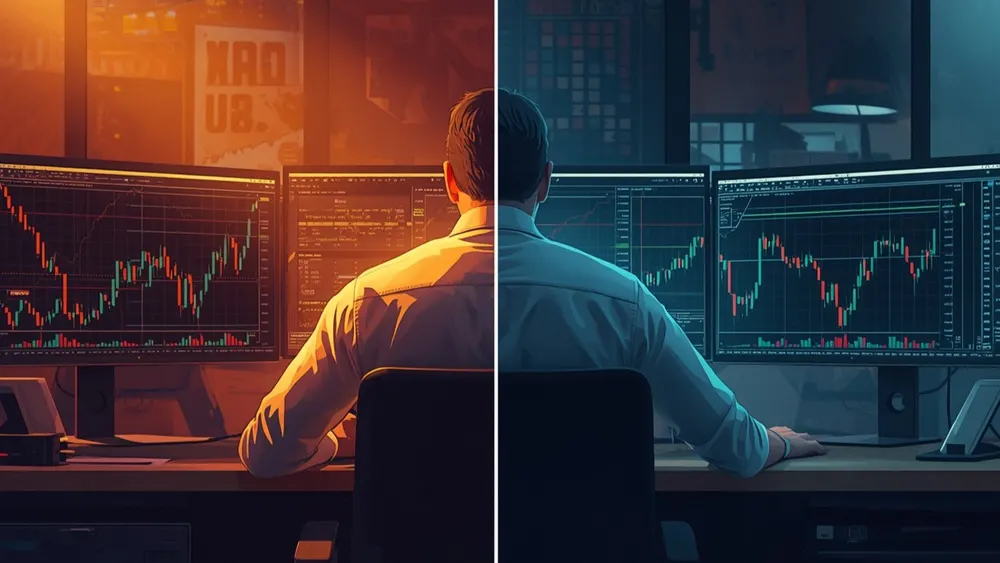
Trader Psychology: How Emotions Influence Decisions in Binary Options
When people talk about the reasons for losses in binary options trading, they most often cite an incorrect strategy or a bad signal. In practice, however, it’s far more common for the trader—or, more precisely, the trader’s reaction to what’s happening on the screen—to be the cause of the loss, rather than the market itself.
A trader’s psychology isn’t some abstract topic for motivational posts, but rather a very specific set of the brain’s reactions to risk, loss, and uncertainty. Understanding these mechanisms helps explain why the same strategy consistently works for one person but results in chaotic trades for another.
Why Trading Is Stressful for the Brain
Every binary options trade involves a brief wait for an unknown outcome, with real money on the line. The brain perceives this situation as a threat, even if the amount involved is small.
In response, the same mechanisms kick in as they do in the face of physical danger: the heart rate increases, attention narrows, and impulsivity rises. This is a normal biological reaction, but in trading it gets in the way—decisions are made not based on chart analysis, but on the back of a hormonal surge.
The problem is that this process happens quickly and goes unnoticed by the trader. The trader is genuinely convinced that he is acting rationally, when in fact he is reacting to emotion rather than to a signal.
Common Emotional Pitfalls
There are several common scenarios that almost every trader encounters at some point. It’s worth knowing about them not to avoid them entirely—which is nearly impossible—but to recognize them in time.
- Fear of missing out—entering a trade without a signal just because the price has already moved in the desired direction
- Loss recovery — increasing the amount of the next trade after a loss in order to quickly recoup the loss
- Overconfidence after a string of successful trades — a decline in attention to entry rules
- Analysis paralysis—the endless wait for perfect confirmation, which causes you to miss the entry point
- Emotional exhaustion after a long trading session—trades are opened mechanically, without the same level of concentration as before
Each of these pitfalls seems logical on its own at the time. The problem is that they rarely occur in isolation—fatigue intensifies the urge to recoup losses, and overconfidence after a win often leads to impulsive trades without a clear signal.

Chasing Losses as the Main Destroyer of Discipline
Of all the reactions listed, revenge trading deserves special attention—it is this behavior that most often leads to a sharp increase in losses over a short period of time. The logic is simple: after an unsuccessful trade, you want to immediately recoup your losses with the next one, often by increasing the amount.
The problem with this behavior is that decisions are made not based on market analysis, but solely out of a desire to restore emotional balance. The market, however, is under no obligation to move in the desired direction simply because the trader wants it to.
How to Build Resilience in Practice
Psychological resilience cannot be “switched on” through sheer willpower alone—it is built through habits and a structured approach to trading. One of the fundamental elements is having predefined entry rules that are not revised in moments of emotional stress.
Another useful tool is setting a limit on the number of trades or on the maximum drawdown allowed per session. Once the limit is reached, trading stops, regardless of how much you “want” to continue.
It’s also helpful to keep a record of each trade—not just the outcome, but also what was happening at the moment the decision was made: whether it was based on clear logic or on emotion. The trader’s journal in the Trading Journal app can help with this task, allowing you to record trades and analyze your decisions all in one place.
Understanding the basic logic behind price movements also reduces emotional stress—when a trader sees the market’s structure rather than chaotic candlesticks, decisions are made with greater composure. You can read more about this in the article “How Market Logic Works”.
The Role of Self-Observation
The most underrated aspect of a trader’s psychology is the ability to recognize one’s own state of mind before it affects a trade. Irritation, fatigue, or excitement after a winning streak—all of these can be spotted in advance if you train yourself to do a quick check before every trade.
It’s not about complicated rituals, but about simply asking yourself: “Am I acting according to a plan or on impulse right now?” Asking this question aloud or silently before opening a trade is often enough to prevent an impulsive decision.
A trader’s mindset is no substitute for a strategy and does not guarantee consistency on its own. But without control over emotional reactions, even a proven entry system will eventually fail due to human error, not because of the market.
Open Trading Journal →