
Trading Basics for Beginners: How to Understand Price Movements
Every successful start in the financial markets begins with an understanding of the basic mechanics. A chart isn’t just a chaotic jumble of lines; it reflects the balance between supply and demand. To start making consistent profits, a beginner doesn’t need to memorize hundreds of complex terms or clutter their screen with dozens of indicators.
The main goal in the early stages is to learn how to identify the current market trend and open trades strictly in the established direction.
The Three Phases of the Market and the Mechanisms Behind Their Formation
The price of any asset can be in only one of three states. Determining the current phase is the first step before looking for an entry point.
- Uptrend: a pattern in which each subsequent high and low is higher than the previous one. Buyers are in control.
- Downtrend: a pattern in which local lows are continuously being updated. The sellers have all the momentum.
- Sideways movement (flat or consolidation): a condition in which prices are confined within a range between an upper and lower boundary.
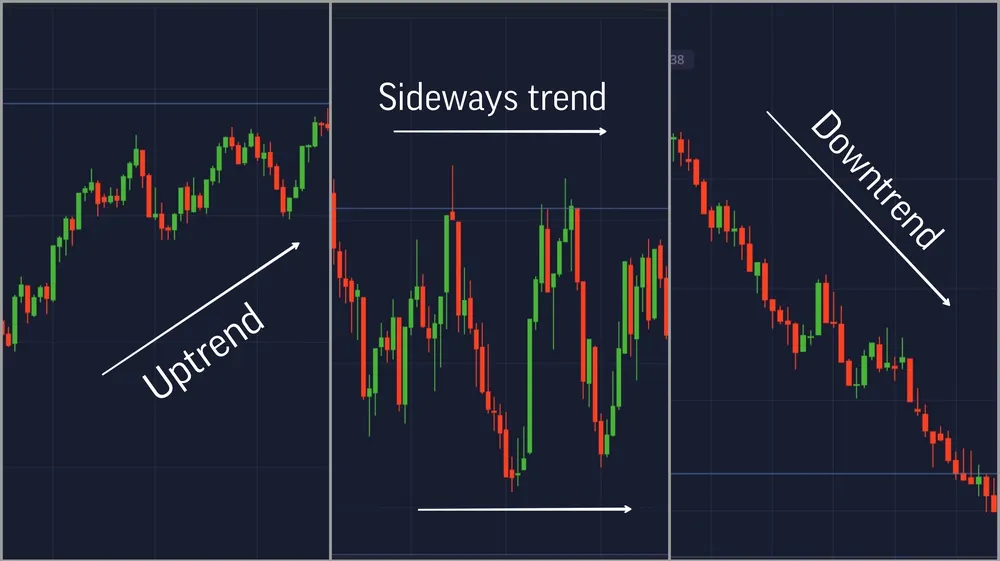
Prices cannot rise or fall indefinitely without temporary pauses. Within a trend, corrective pullbacks always occur—these are moments when one side takes profits while the other tries to resume the upward or downward pressure.
The "Clean Chart" Principle and Two-Level Analysis
Using too many indicators does not improve the accuracy of a forecast. An overloaded chart creates information noise, confuses the trader, and leads to delayed decisions.
Using Higher and Lower Time Frames
To identify entry points with a high win rate, use a combination of two time frames:
- Higher time frame (5 minutes): used to identify the overall trend. You can immediately see who is dominating the market—buyers or sellers.
- Lower timeframe (1 minute): used to analyze the structure in detail and identify precise entry points for trades in the direction of the main trend.
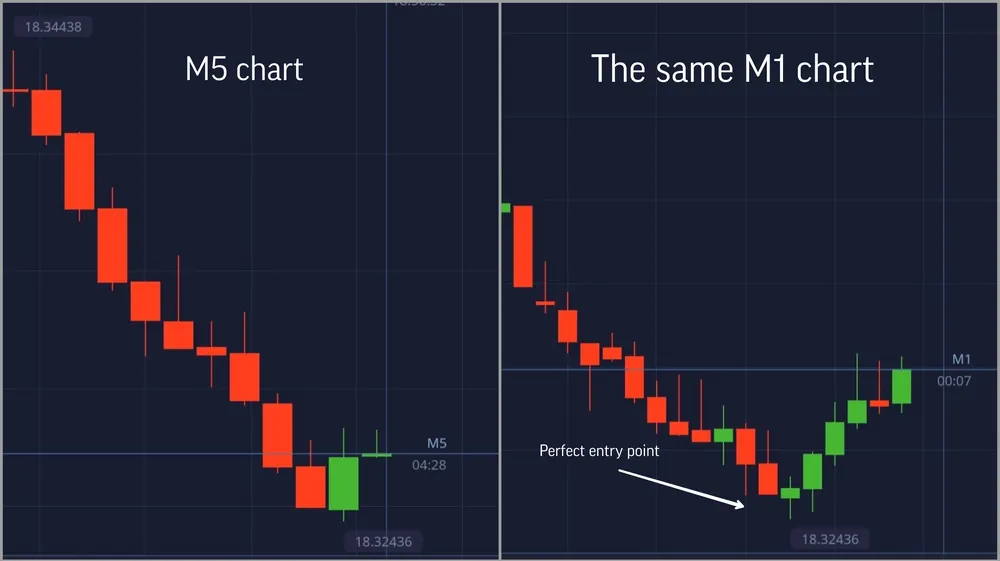 Analysis of Higher and Lower Time Frames
This selection of intervals allows you to combine entry precision with an understanding of the overall market trend. To better understand how to allocate your attention when selecting zones, learn how to properly set up a level-based trading strategy on your trading screen.
Rules for a Safe Start in Trading
To minimize risks during the early stages, follow a clear set of procedures:
- Trade only in the direction of the primary trend on the higher time frame.
- Skip trades in the middle of a sideways range—enter only at its outer boundaries.
- Do not open trades when major economic news is released.
- Set the size of a single trade at no more than 1–2% of your current deposit.
Systematic analysis and risk management transform trading from a game of chance into a clear mathematical model. For a more precise understanding of momentum reversal points, we also recommend studying how the breakout strategy is identified on short time frames.
Open Trading Journal →