
What Is Trading on Pocket Option?
There’s a myth going around in chat rooms and in the comments under videos about making money: supposedly, trading on Pocket Option is just a matter of tapping “up” or “down” and waiting a minute. It’s like a slot machine, only with a chart instead of reels. It sounds tempting, but it’s precisely because of this mental image that most beginners lose their deposit within the first couple of days.
In reality, trading on Pocket Option isn’t about luck—it’s about a dozen small decisions you make before your finger hits the trade button. We often see people skip this preparatory step and jump right into trading. The result is predictable.
Where Does Trading Really Begin?
Signing up and funding your account is the technical part—anyone can handle that. Trading really begins when you have to decide which asset to trade, what expiration time to set, and how much to risk. This is where the questions begin—questions to which a beginner rarely finds a clear answer.
How much money do you need to get started?
There is no one-size-fits-all figure, and anyone who calls a specific amount “the right one” is being a bit disingenuous. What matters more than the balance itself is the size of a single bet relative to that balance. If the deposit is small but the bets are large, just a few losing trades will be enough to wipe out the account—and that has nothing to do with luck.
Which asset should you choose for your first trades?
It makes more sense to start with currency pairs or assets whose price movements you’re at least somewhat familiar with. Exotic instruments with sharp price swings may seem tempting because of their high returns, but their behavior is also harder to predict. To start, it’s better to choose one or two assets and figure out how they behave at different times of the day rather than spreading yourself too thin across a dozen confusing charts.
A demo account or real money right away
Demo mode isn’t just there for show. It’s the only place where you can practice clicking the right buttons, get familiar with the interface, and try out different expiration times without any financial consequences. The problem is that the mindset in demo mode and on a real account are two different states, and the transition between them should be gradual, not abrupt.
Let me tell you about one instance. A trader I know decided that a demo account was a waste of time and deposited a substantial amount into a live account right away. The first trades went well, his excitement grew, and his bets got bigger. By evening, his deposit was gone—and he had to figure out what went wrong with no money left in his account. It’s a common story, but one that repeats itself with alarming regularity.
How to Choose an Expiration Date
This is one of the most common questions from beginners—and one of the most underestimated. A short expiration of just a couple of minutes requires a sharp, precise price movement and leaves almost no room for errors in analysis. A longer expiration—15–30 minutes or more—gives the price time to “reach” the expected direction, but it also requires patience, which beginners usually lack.
- An expiration period that is too short turns trading into a guessing game based on market reactions rather than analysis
- An expiration period that is too long amplifies the impact of random price fluctuations within that period
- The optimal time often depends on the asset and current volatility, rather than on personal preferences
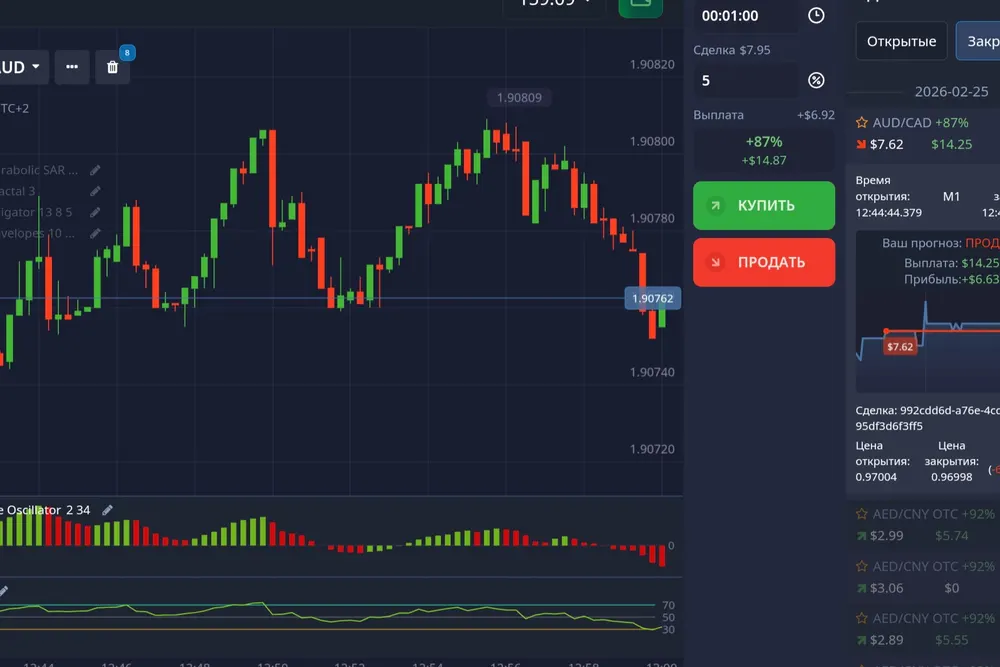 trading platform interface
Do You Need a Strategy, or Is Intuition Enough?
Intuition sometimes works, but you can’t build anything sustainable on it alone. It’s much wiser to rely on clear signals—candlestick patterns, price behavior at key levels, and reactions to news. If you haven’t seriously explored this topic yet, it makes sense to first learn how to read candlesticks in trading before opening your first trade with real money.
A separate issue is the size of the bet and how to allocate your deposit among trades. The same logic applies here as in any other form of trading: without risk management, even a good entry point won’t save your account from being depleted. This topic is covered in more detail in the article on risk management for binary options, and you definitely shouldn’t skip it.
So what does it really mean to know how to trade on this platform? It’s not about guessing the color of a candlestick—it’s about developing a habit: checking the asset before entering a trade, keeping your position size under control, and not getting carried away after a string of successful trades. Boring? Perhaps. But it’s precisely these boring habits that make the difference between someone who lasts a month in the market and someone who trades for years.
If it’s easier to record trades and analyze them in retrospect—that, too, is part of discipline, not just an unnecessary formality. To do this, you can keep a trading journal—for example, using Trading Journal—so you can see the true picture of your decisions rather than relying on your memory.
Open Trading Journal →