What I've Learned About Binary Options
Imagine this: the price approaches a level it has already bounced off twice today. The candlestick hovers at that threshold, as if hesitating. At that moment, someone opens their trading platform, glances at the clock, and makes a decision—up or down in five minutes. That, in a nutshell, is the entire binary option in a single move.
Over the years I’ve been in this market, I’ve seen dozens of ways this term has been defined—from dry textbook definitions to marketing copy promising easy money. Neither of these fully captures the essence of the concept. It’s easier to show once how it works in practice than to explain the theory.
What Happens Behind the Scenes of a Single Transaction
Let's take the EUR/USD pair. The price has approached a certain level, and the trader places a bet that in five minutes the price will be higher than the current level. That is the essence of this instrument—it’s not about buying or owning the asset, but rather betting on the direction of its movement over a fixed period of time.
The option expires in five minutes. There are exactly two possible outcomes: if the price is above the entry point, the trade wins and yields the predetermined payout; if the price is below, the stake is lost in full. There are no intermediate results and no partial profits as the chart moves. It is precisely this binary nature that gave the entire instrument its name.
Where does the payment come from?
It’s worth focusing on a specific figure here, because the entire economics of the trade revolve around it. Let’s take a typical payout percentage—80%. If the stake was 10 notional units and the trade was profitable, the trader receives their 10 plus another 8—for a total of 18. If the trade loses, the entire 10 is lost, not just a portion of it.
This asymmetry isn’t just a minor detail—it’s the foundation of the entire mathematics of binary options. In absolute terms relative to the deposit, a win yields less than the loss incurred when a trade is lost. This is the basis for the entire concept of the win rate—without which the instrument simply won’t pay off in the long run. For more details on how to protect your capital while taking this characteristic into account, see the article on risk management for binary options.
How It Differs from Traditional Trading
In the stock market or in traditional Forex trading, profits rise or fall along with the price of the asset. You can close a position early, or you can hold it for as long as you like; the size of the profit depends on the magnitude of the price movement. In binary options, the expiration time is set in advance, and the outcome does not depend on how many points the price has moved—only the direction at the time of expiration matters.
This simplifies the decision—you don’t need to think about the magnitude of the movement, just the direction and the time frame. But simplifying your thinking doesn’t mean the task itself is any easier. Predicting the direction over a short time horizon is no easier than assessing the strength of a trend in a traditional market—it just sounds simpler.
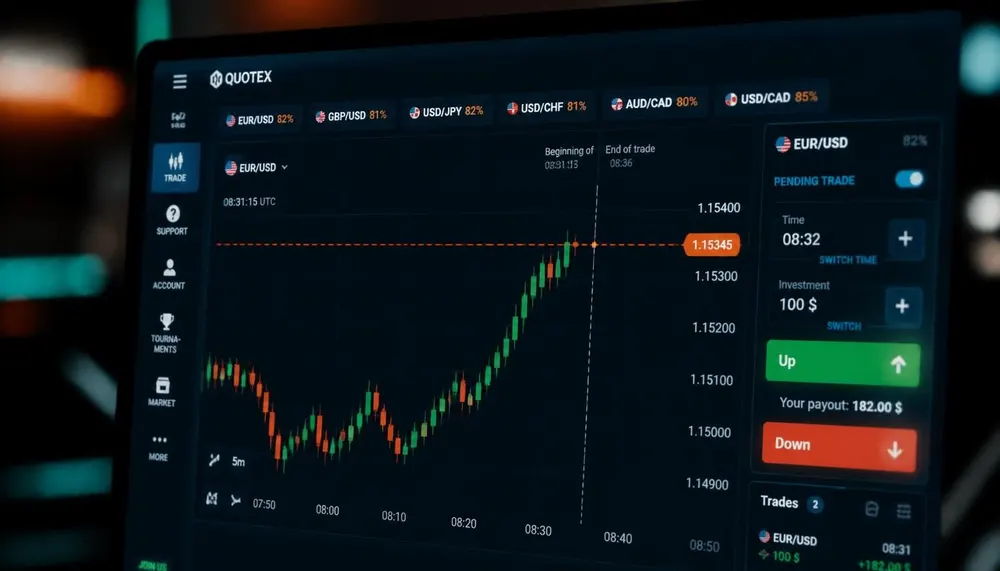 terminal with an expiration timer
Why One Successful Deal Isn't Enough
Going back to that candle at the level—it turned out to be a winner. But a single trade proves nothing one way or the other. Behind it lie a dozen similar situations where the price behaved differently, rebounded in the wrong direction, or broke through the level without hesitation.
Understanding the mechanics is just the first step. Next comes working with the logic of price movement, recognizing recurring patterns, and—just as importantly—controlling your own reactions after a string of losses. The issue of emotions is particularly acute here, because short expiration times push traders toward quick, often ill-considered decisions—this is the subject of a separate discussion on trader psychology.
In Conclusion
The tool is simple in design—stake, direction, time, result. But the simplicity of the mechanics doesn’t mean the results will come easily, and confusing the two is a fairly common mistake among those just starting out. Recording every trade and analyzing it later with a clear head isn’t the most exciting habit, but it’s an effective one, and a standard trading journal like Trading Journal works well for this purpose.
So what is it, ultimately, that appeals to people about this framework—the simplicity of choosing between two outcomes, or the illusion that predicting the direction is easier than it actually is?
Open Trading Journal →